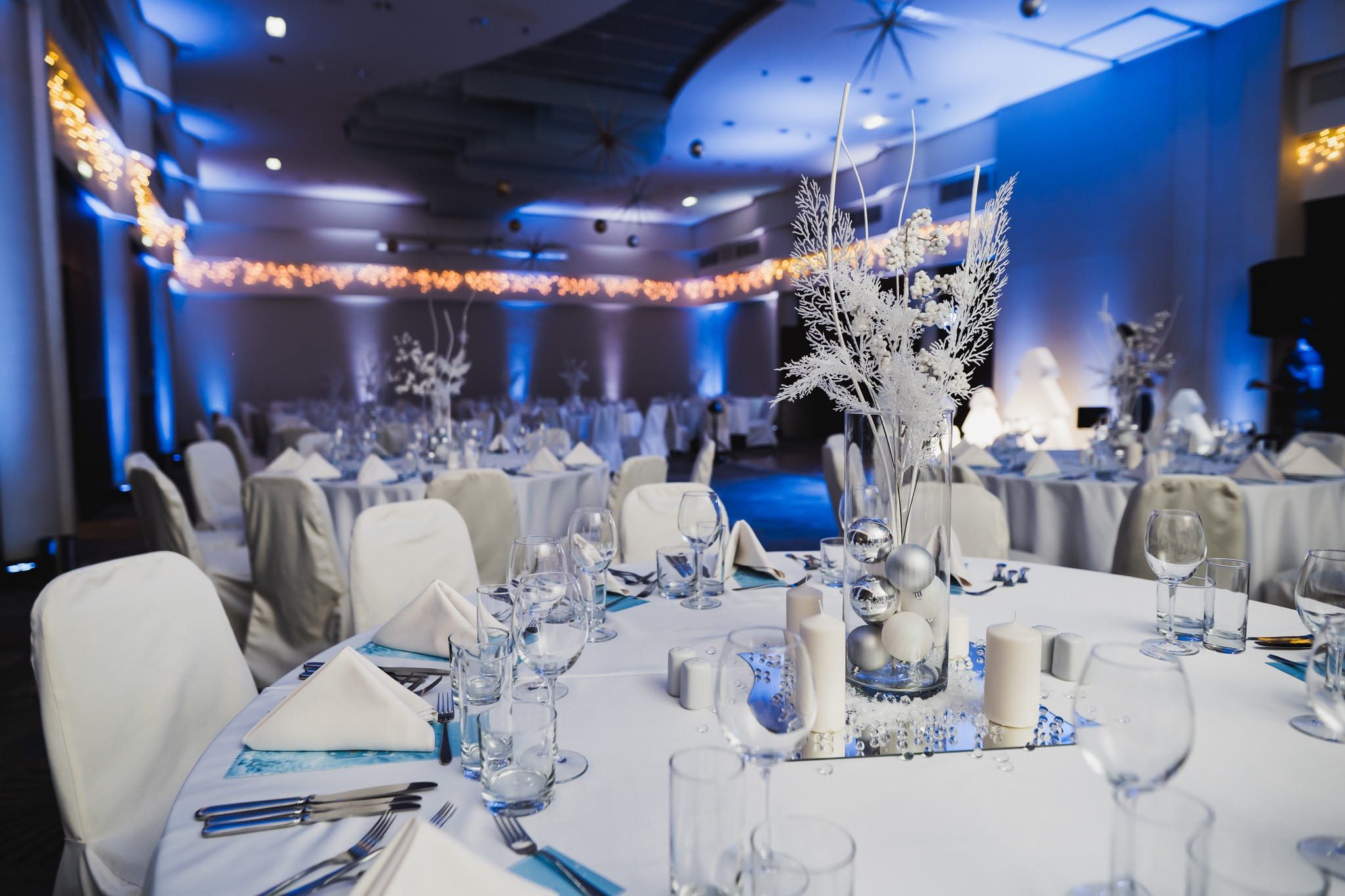
“How much will the Christmas party cost?” sounds like a question that should have a simple answer.
In practice, there is no single per-person figure that works for every company.
A dinner for 50 people in a restaurant, an evening for 200 guests in a hotel ballroom and a corporate event for 500 employees with a stage, technical production and entertainment are three completely different projects.
When planning a company Christmas party, the budget depends not only on the number of guests but also on a series of decisions that are closely connected.
Start with the total budget, guest count and format
Before looking for a venue, it helps to answer three questions:
- How many people do you expect?
- What is the maximum total budget?
- What kind of evening do you want to create?
These three parameters influence almost every decision that follows.
If the total budget remains fixed while the guest list grows, the available spend per person falls. If you choose a formal gala dinner instead of a cocktail reception, the cost structure changes again.
It is also important to decide early whether employees can bring partners or guests. For a large company, this decision alone can significantly increase attendance.
1. A venue costs more than the room hire
A corporate Christmas party may take place in a restaurant, hotel, dedicated event venue, club or another suitable space.
When comparing proposals, look beyond the room hire fee.
The quotation may or may not include:
- furniture;
- technical equipment;
- service staff;
- cloakroom;
- security;
- cleaning;
- parking;
- overtime;
- setup and dismantling;
- minimum food and beverage spend.
A lower venue fee does not automatically mean a lower final cost.
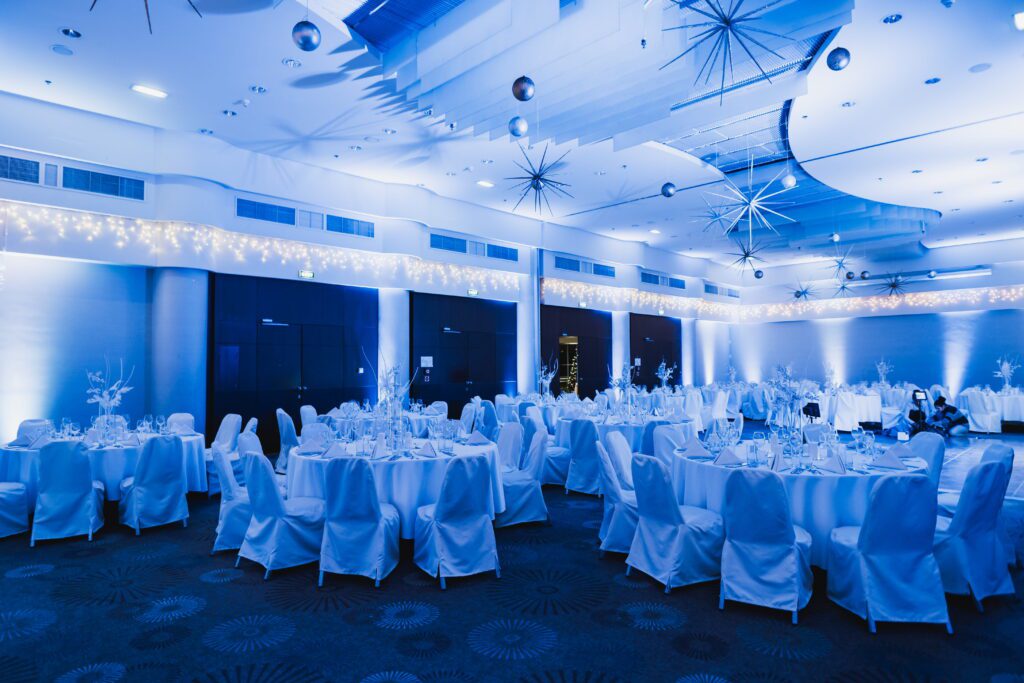
2. Catering and drinks usually scale with the guest count
Food and beverages are among the most visible variable costs.
With 100 guests, almost every increase in the per-person cost is multiplied by 100. With 300 guests, even a relatively small change becomes significant.
There is a substantial difference between:
- cocktails and canapés;
- a buffet;
- a seated dinner;
- a multi-course menu;
- a standard beverage package;
- an open bar;
- a premium drinks selection.
Duration matters as well. A four-hour event and a party running into the early hours have very different requirements for the bar, catering and service teams.
3. Entertainment can be simple or become a production of its own
A DJ and host represent one level of planning.
A live band, performances, awards ceremony or elaborate themed concept require a different budget.
Before adding an element to the programme, ask one simple question:
What role does it play in the event?
You do not need five different activities just to make the programme look busy.
One strong music concept and a well-planned flow can work better than an overloaded entertainment schedule.

4. Technical production is often missing from the first estimate
A stage, LED screen, professional sound, lighting, microphones and technical crew may be essential rather than optional extras.
The requirements depend on both the programme and the venue.
If the evening includes a management speech, awards, video content, a DJ or live performers, the technical setup should be specified before the final budget is approved.
Otherwise, a venue that initially looks “ready to use” may require substantial additional equipment.
5. Décor can change the budget considerably
Christmas styling can range from a few carefully selected details to a complete visual concept.
Sometimes the existing venue atmosphere does most of the work and only a small amount of branded decoration is required.
A more elaborate concept might include:
- stage design;
- specialist lighting;
- floral arrangements;
- branded structures;
- a photo wall;
- themed installations;
- custom-made elements.
Define what the décor is expected to achieve before deciding how much to spend on it.
6. Remember the costs guests rarely see
Some important budget items remain almost invisible to attendees:
- transportation;
- technical staff;
- hostesses and registration support;
- photography and video;
- security;
- logistics;
- setup and dismantling;
- supplier overtime;
- employee gifts.
These details are often the reason why an initial rough estimate differs from the final project cost.
How should you structure the budget?
A practical approach is to divide expenses into two groups.
Variable costs, which are largely driven by the number of guests:
- food;
- beverages;
- gifts;
- participant transportation;
- some service costs.
Fixed or relatively fixed costs:
- venue hire;
- DJ or performers;
- stage;
- technical production;
- décor;
- photography;
- event management.
This makes it much easier to understand what happens if the guest count increases from 150 to 180, for example.
An illustrative budget model
Imagine a hypothetical total budget of BGN 30,000. This is not a quotation or a recommended market rate. It is simply an example of how a budget might be structured.
For example:
- BGN 13,000 – venue, food and service;
- BGN 4,500 – beverages;
- BGN 3,500 – technical production;
- BGN 3,000 – music and entertainment;
- BGN 2,000 – décor and branding;
- BGN 1,000 – photography or additional activities;
- BGN 3,000 – contingency for logistics, changes and unexpected costs.
A different event format could produce a completely different allocation.
The point is to manage the budget as one system rather than as a collection of unrelated purchases.
Where can you save without making the party feel cheap?
Avoid reducing every budget category by the same percentage.
Instead, decide which two or three elements matter most for your event.
You might choose:
- a strong venue that needs less decoration;
- a DJ instead of a live band;
- a carefully selected menu instead of an excessive number of dishes;
- a defined drinks package instead of an unlimited premium bar;
- one high-quality activation instead of several average ones.
The objective is not to spend the maximum budget. It is to invest where guests will genuinely notice the difference.
Sometimes the most expensive decision is a late decision
December is a concentrated period for corporate events.
When planning starts late, the choice of suitable dates, venues and suppliers becomes smaller. This can leave a company with an option that costs more or simply does not fit the event as well.
Early planning does not automatically guarantee a lower price, but it provides more alternatives and much better control over the budget.
So how much does a company Christmas party actually cost?
A meaningful answer is only possible once you know:
- the number of guests;
- the date;
- the venue;
- the format;
- food and beverages;
- entertainment;
- technical requirements;
- décor;
- logistics.
That is why a useful event budget does not begin with:
“How much does it cost per person?”
It begins with:
“What kind of event do we want to create, and which elements genuinely matter to our team?”
If you are planning an end-of-year event, Insight Events can support the process from concept and venue sourcing to catering, entertainment, technical production, logistics and on-site coordination.
For complete corporate event planning and management, visit Insight Events.

